

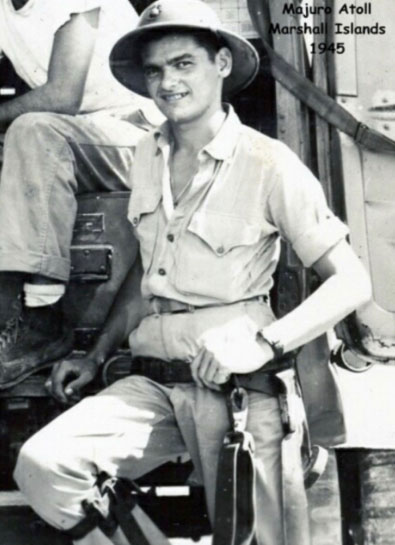
 On Memorial Day of 2016, Melinda Tourangeau, Business Manager and Co-Founder of Warrior Support Solutions, spent part of the day interviewing a local World War II veteran in Milford, NH: Cpl. Normand Laquerre. Warrior Support Solutions values and honors all warfighters. It is extremely important to our mission that we preserve and value our veterans’ stories. Interviewing WWII veterans allows us to remember the sacrifices they made, and immortalize the bravery they displayed in defending our country. World War II ended 71 years ago in 1945, making the last of “this greatest generation1” very elderly indeed. To be able to spend time with a World War II Veteran today and hear his stories personally is an honor and a privilege.
Normand Laquerre was eighteen years old when he joined the U.S. Marine Corps on February 29, 1944 during World War II. At the time he was living in Nashua, NH, where he grew up. Initially he joined the Navy, knowing he was going to be drafted soon anyway. Before setting off for basic training, he was selected to join the Marines. Joining the service voluntarily rather than being drafted had its benefits–you had less KP (kitchen patrol) duty and other tedious jobs. During his service, Laquerre was ranked as Private First Class, and upon discharge he was promoted to Corporal.
Laquerre was sent to Parris Island, SC, for basic training for approximately ten weeks. He was then sent to Camp Lejeune, NC for infantry training. There, he learned how to install field telephones as an amphibious Marine. He was trained to climb trees and set up wire telephones. His job would be to invade islands with a squad of Marines, and immediately set up telephones in trees. During training, they practiced sea landings every other day, during which live explosives were used to accustom the soldiers to the overwhelming explosion of firearms they would encounter when landing on islands. During landings, field telephone infantrymen carried a large line of wire on their backs, and two telephones on each shoulder. Because of this, they were not able to carry M1 rifles to defend themselves; instead they carried a 45-caliber pistol. The survival rate for field telephone infantrymen was very low as they were usually the first to be shot at by the enemy. During WWII, it was imperative that wire communication be used as much as possible because radio communication could be intercepted or jammed by the enemy who understood English. [This is a perfect example of early Electronic Warfare. The enemy was able to intercept radio signals, so our military took steps to suppress or deny that ability. This is called, Electronic Protectioni].
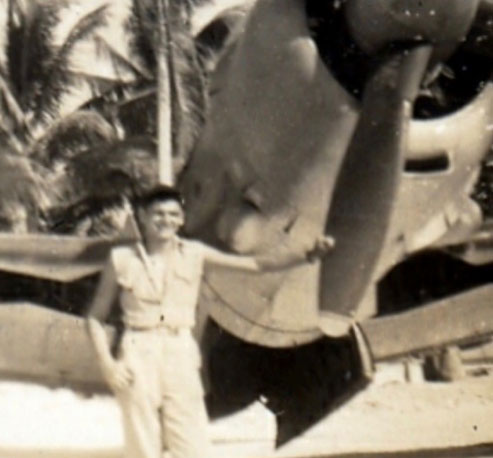 At the end of his training, before getting shipped overseas, Laquerre was reassigned. An officer showed up from Cherry Point, and informed Laquerre and his fellow soldiers that those whose last names began with A-L would join the Marine Air Group (MAG), and M-Z would land at Iwo Jima. This meant he would not be involved in island invasions as he was trained to do. Instead he would work on a US air base in the Pacific Ocean. Many of the men in the M-Z group died.
In September of 1944, Laquerre was shipped overseas to Majuro Atoll, part of the Marshall Islands in the middle of the Pacific Ocean. Laquerre recalls stopping at Pearl Harbor on the way, where he saw the ships that had been bombed by the Japanese. Majuro Atoll was previously occupied by the Japanese, who were in the process of setting up a base there. The island was 15 feet above sea level, with no mountains or hills, and very few trees, rendering the island virtually indefensible. Because of this, when the Japanese were informed the Americans were coming to the island, they abandoned it. When Laquerre and his squad arrived at the island, the only people there were the native islanders. They built an airfield on Majuro Atoll, which became an important airfield where planes came to refuel between Hawaii and Japan. Laquerre says that luckily for him, Majuro Atoll was never bombed. Just 260 miles away, the next drop off island from Majuro was the island of Kwajalein Atoll, a landing base for B24 and B25 planes, which was severely bombed during the war. Laquerre says they were told just one tree was left standing on the island after the bombing.
Laquerre was stationed on Majuro Atoll from September 26th, 1944, to November 6th 1945. While he was there he set up and repaired telephones, and worked switch board duty. By late July 1945, they had broken up camp, and were loading their equipment onto ships in preparation for an invasion of Japan during the final stage of WWII. On August 6th, 1945, the U.S. dropped a uranium atomic bomb (Little Boy) on Hiroshima, Japan. 16 hours later, President Truman called for Japan’s surrender, warning them to, “Expect a rain of ruin from the air, the likes of which has never been seen on this earth.” Three days later, the U.S. dropped a plutonium bomb (Fat Man) on the city of Nagasaki. Six days after the second bombing, Japan announced its surrender to the Allies. Laquerre reports that apparently the Generals of the Japanese military wanted to continue fighting, but it was Emperor Hirohito who called for surrender, fearing the U.S. would burn down Japan.
Japan and the rest of the world were unaware that the U.S. only possessed two bombs. Had Japan not surrendered after the second bomb, the U.S. would have invaded Japan, and Laquerre would have reverted back to being a telephone infantryman for the landing. Laquerre says that everyone in the service knew that landing on Japan would be terrible. They believed this because of the religious nature of the people of Japan. They predicted every civilian man, woman, and child would take up arms against them, in addition to Japanese soldiers. It would have been worse than landing in the English Channel which was in a very violent state.
 Laquerre acknowledges the bombings of Japan were horrible, but he believes it saved his life and the lives of many others. Many lives, both American and Japanese, would have been lost in the event of an invasion. Laquerre says he gives so much credit to Truman for doing what he did to end the war and save American lives.
At the end of the war, the process of being sent home was based on a points system. The ones who came home first were the ones who had gathered points in battle. Because Laquerre was never in battle, he didn’t leave the Pacific until November 1945. Laquerre says he counts himself very lucky to have never met the enemy during his time in the service.
Interviewing Mr. Laquerre on Memorial Day preserved another vital story in our country’s history with its Veterans. We hope that capturing these stories pays tribute to all Veterans who didn’t return home to tell their stories. Our hearts go out to each family in all wars, at all times, who have made the ultimate sacrifice. Warrior Support Solutions stands in solidarity with you, and will continue to provide our services in Electronic Warfare expertise so that every warfighter from now on has the greatest chance of telling their own stories for years to come.
Written by: Alyson Bermudez